
When comparing “Prime–X%” mortgages, remember that interest compounding frequency makes a big difference. Most of the big banks (RBC, TD, BMO and CIBC) compound monthly, while lenders like Scotiabank (and many monoline mortgage lenders) compound semi-annually. Since monthly compounding adds interest more often than semi-annual, it raises the effective rate. In practice a 5.00% rate compounded monthly works out to about a 5.12% APR, versus ~5.06% if compounded semi-annually. Over the full mortgage term this “tiny” gap could add up, potentially costing you thousands of dollars more in interest.
- Monthly-compounding lenders: RBC, TD, BMO (and likely CIBC) calculate interest monthly. For example, TD’s site explicitly notes its variable rates are “calculated monthly, not in advance”.
- Semi-annual lenders: Scotiabank’s variable mortgages are compounded semi-annually (like traditional fixed-rate loans). Monoline mortgage banks typically do this too.
Because of compounding, a semi-annual loan will cost slightly less. For instance, over 25 years a $300,000 mortgage at (Prime–0.90%)* ends up saving roughly $1,200–$1,300 in total interest when compounding is semi-annual instead of monthly. (Using current prime ≈4.45%, Prime–0.90%≈3.55%, the monthly payment would be about $1,510 with monthly compounding vs ~$1,506 with semi-annual – roughly $4 less per month, or ~$1,260 over 25 years.) This effect is exactly why compounding frequency is worth watching, especially when comparing 2 products of the exact same rate.
How Payment Frequency Affects Costs
Some lenders tie the compounding period to your payment schedule. For example, RBC’s variable-rate mortgage uses your payment frequency as the interest period. That means if you switch from monthly to accelerated bi-weekly payments, RBC effectively compounds interest every two weeks (instead of monthly), making your interest cost slightly higher. Scotia’s semi-annual compounding will stay the same no matter how you pay.
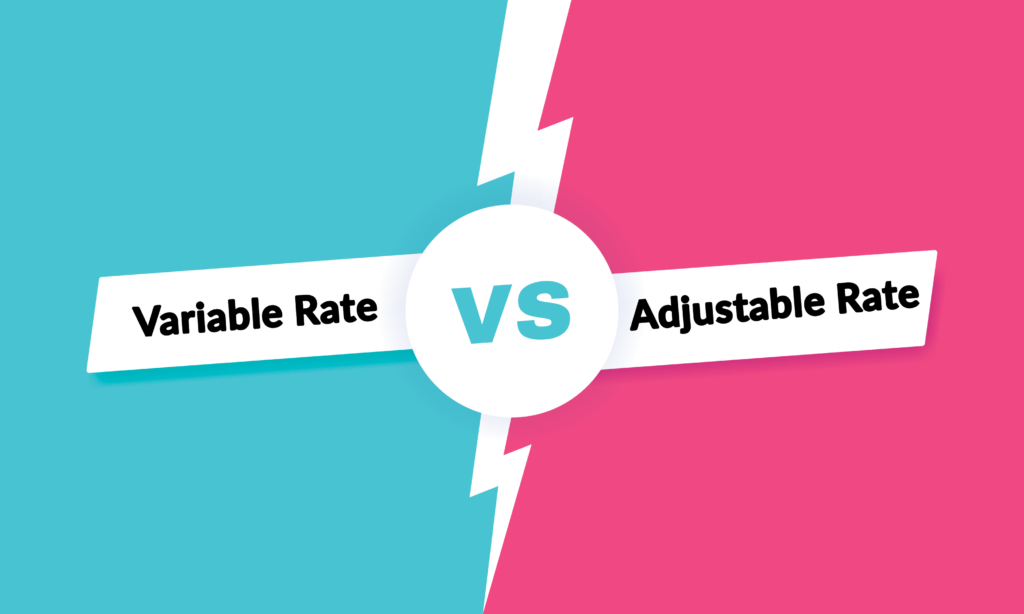
Variable vs Adjustable Mortgages (VRM vs ARM)
In Canada, a Variable-Rate Mortgage (VRM) usually means fixed payments that float with the lender’s prime. Your monthly payment stays the same each period, but the portion of interest vs principal shifts as prime changes. A trigger-rate feature is built in so that if rates climb too high then your fixed payment might not cover all the interest, causing the mortgage balance to grow (negative amortization). In effect, VRMs hide rate rises until renewal: you may pay more total interest and face a higher payment or lump-sum at renewal if your loan balance/increasing amortization got out of line because of rates going up. Such was the case for variable rate holders in 2022 when the prime rate started to increase significantly.
An Adjustable-Rate Mortgage (ARM) changes your payment amount as prime moves. When interest rates rise, your payment goes up immediately (and vice versa). This means that your amortization schedule will stay on track (no hidden balance growth), but you get payment swings. In short:
- VRM: Payment is fixed. Interest portion rises/falls with rates, and you get a “trigger rate” risk (eventually you may need to pay more or a lump sum if interest grows faster than your payment). Good for budgeting short-term, but can lead to surprise costs later.
- ARM: Payment floats with prime. No trigger– your mortgage amortizes as planned, but your budget must handle variable payments.
Either way, variable products typically allow large prepayments and easier switching (lower penalties than fixed), but you take on rate risk.
Porting Your Mortgage
“Porting” lets you move your current mortgage to a new home without breaking it. However, not all mortgages, especially variable ones are portable. In fact, most variable rate mortgages cannot be ported. (Each lender’s rules differ.) For example, Scotiabank does allow porting its variable-rate (Scotia Flex) mortgages, letting you take your rate and terms with you. But other lenders may treat a VRM like a closed term that can’t be moved.
Penalties
While all variable rates carry a 3 month interest penalty, for some lenders this could mean a higher amount in comparison to others. How the interest amount is calculated matters here. Lenders like TD calculate the 3 months of interest based off your contract rate(so if you are at Prime – 1% which is 3.45%, your 3 months interest is calculated on the 3.45%). Other lenders will calculate the penalty based off the prime rate, which is currently at 4.45%. This could mean a much larger penalty when breaking early, as the interest amount off the prime rate would be significantly higher than your contract rate.
Key Takeaways
- Watch the compounding: Even with identical quoted rates, monthly vs semi-annual compounding means different effective costs. Over a 5-year term, that small APR gap can equal thousands in interest.
- Payment timing matters: Most banks fix their compounding (monthly or semi-annual), but some (like RBC’s VRM) compound at the payment frequency. More frequent payments may speed payoff but can technically raise interest if the lender compounds more often.
- VRM vs ARM: Variable Rate Mortgages keep your payment steady, risking “catch-up” costs later if rates rise. Adjustable-Rate Mortgages change payments with rates, so you see increases immediately but avoid hidden amortization risk.
- Porting policies vary: If you think you’ll move, confirm whether your VRM can be ported. Some lenders (e.g. Scotiabank) allow it; others generally don’t.
- Penalties can vary: Some lenders like TD calculate your 3 months interest penalty off your contract rate, whereas others calculate it off the prime rate which leads to a much higher 3 month interest penalty.