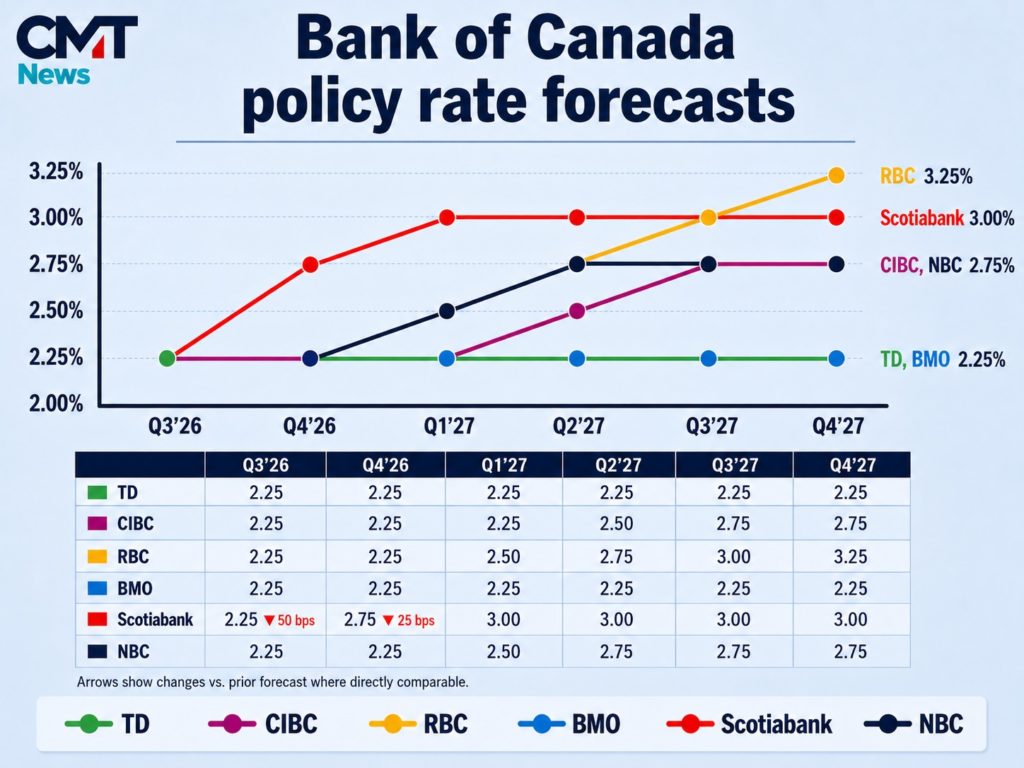
Right now, Canada’s Big Six banks are pretty much on the same page about one thing: the Bank of Canada is expected to keep its overnight rate around 2.25% for the rest of 2026.
After that, things get much less clear, where some banks think rates will start moving higher in 2027. Others think that the Bank of Canada could leave rates exactly where they are for the entire year(2027).
There’s also the wildcard nobody can ignore right now: the Canada-U.S. trade war.
What are the banks predicting for 2027?
Here’s where the major banks currently stand:
Scotiabank is expecting rates the rates to move higher first. Their forecast has the Bank of Canada moving up to 0.50% in Q4 2026, followed by another increase of 0.25% in early 2027.
National Bank is forecasting an increase of 0.25% in Q1 2027, followed by 0.25% in Q2.
CIBC doesn’t expect increases to begin until Q2 2027, with the rates going up by approximately 0.50% by Q3.
RBC has one of the more aggressive forecasts. It expects the overnight rate to increase by 0.25% in Q1 2027 and eventually climb another 0.75% by the end of 2027.
TD and BMO are taking a completely different view. Both currently expect the Bank of Canada to leave the overnight rate at as-is through the end of 2027.
Depending on which bank you believe, we could have anywhere from no increases at all to a full 100-basis-point increase over the next year or so. Much will also depend on what happens with the current trade war..
The Tariff Wildcard
The latest breakdown in Canada-U.S. trade negotiations has added another layer of uncertainty to the economic outlook.
The U.S. has imposed 50% tariffs on roughly $20 billion of Canadian goods, and prime minister Mark Carney announced Canadian retaliation. Thus dispute has escalated with additional threats involving Canadian automobiles and parts.
Normally you’d think tariffs mean higher rates because tariffs can push prices higher, and that’s certainly a risk, but there’s another side to it. If the tariffs seriously hurt Canadian exports, business investment and employment, the Canadian economy could slow down significantly.
Bond yields have already started moving
As of today (August 24), the Government of Canada bond market has been reacting to the latest trade developments.
The 5-year Government of Canada yield is currently around 3.274%, and fixed mortgage pricing continues to move with government bond yields and lender funding costs.
If the recent downward pressure on bond yields continues, lenders could have room to reduce fixed mortgage rates.
Bottom Line
- 4 of the big 6 banks project rate increases through 2027.
- Bond yields are down as of today(August 24th) by almost .10%. When bond yields drop, fixed rates often decrease too.
- The most probable path for now is elevated inflation and slower growth